Riding Bareback, and Monitoring for Signs of Poor Saddle Fit
Riding Bareback, and Monitoring for Signs of Poor Saddle Fit.
This post pulls together everything I've been sharing about saddle fit lately. We'll start with where your weight belongs, look at what happens when your saddle puts you somewhere else, then walk through what a poorly fitting saddle leaves behind on a real horse.
Where your weight belongs: T13 to T15
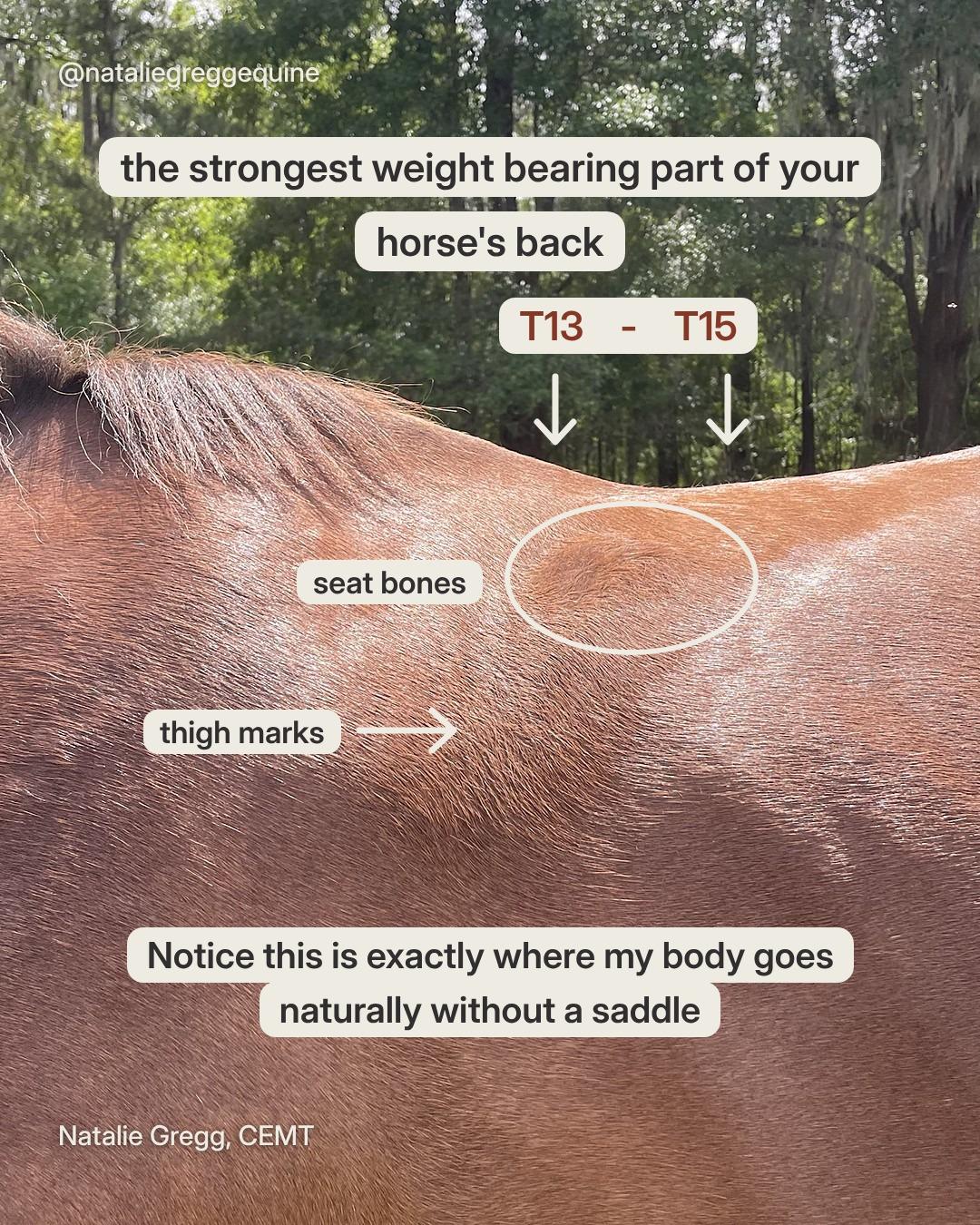
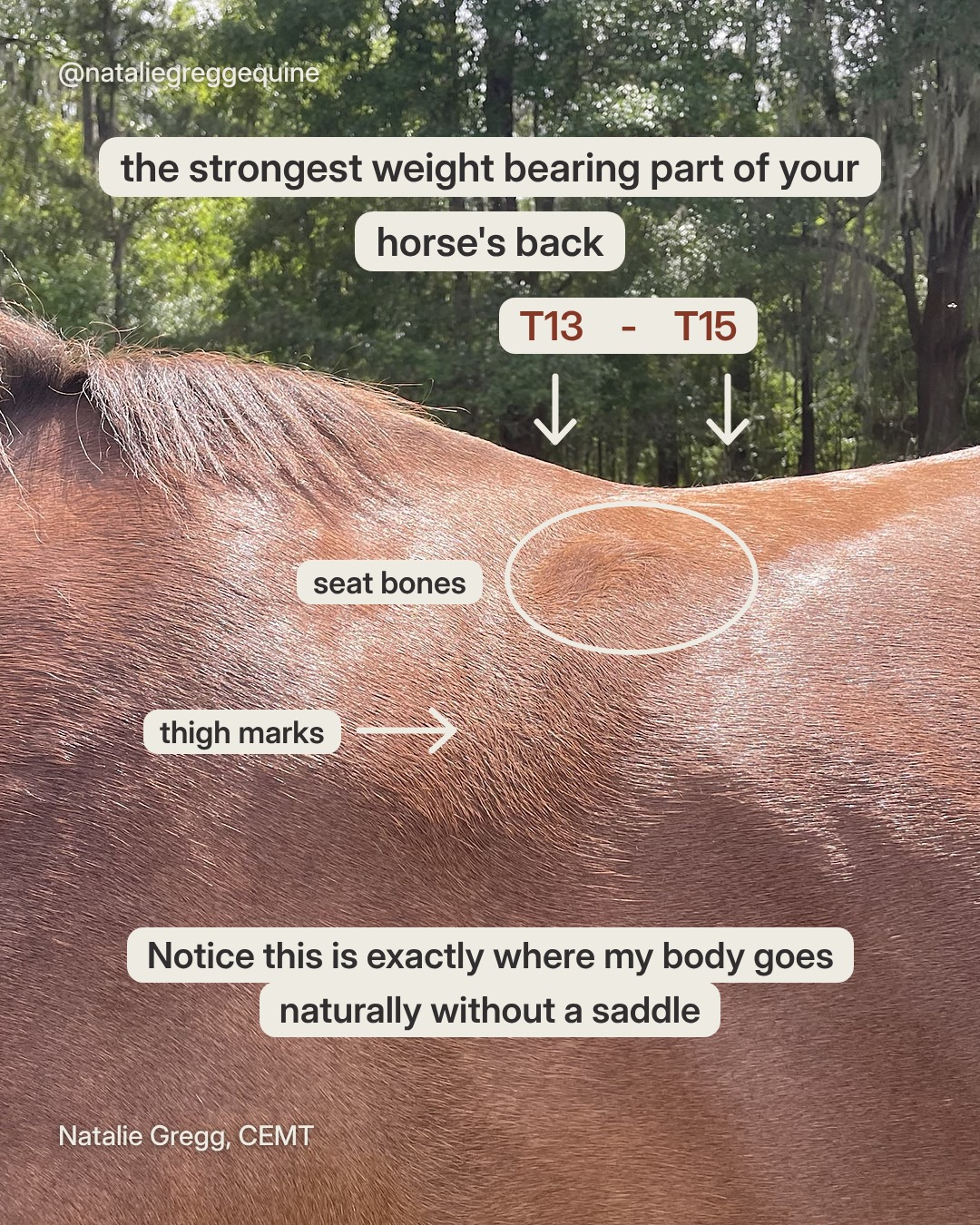
The strongest part of your horse's back is thoracic vertebrae 13 to 15 (T13 to T15). This is the area best built to carry a rider, and it's where the center of your weight should land every ride.
Here's how I know your body already understands this. After a bareback ride, look at the sweat on your horse's back. The marks from your seat bones and thighs land right over T13 to T15. Without a saddle, your seat settles there on its own.
That's exactly where a well fitted saddle should put you too. Two boundaries matter just as much:
In front,the saddle needs to sit behind the shoulder blade so it never blocks the shoulder as it rotates back with each stride.
Behind,it should end before the last rib. Past that point you're on the loin, which has no ribs underneath to help carry a rider.
Next time you ride bareback, notice where your seat lands. Then tack up and ask yourself honestly: does my saddle put me in the same place?
When your saddle puts you somewhere else
A saddle that doesn't fit doesn't just sit wrong. It moves your weight off the strongest part of the back, and your horse pays for it with every stride.
If it tips you forward,your weight lands closer to the scapular cartilage, which is a huge no-no and will probably give your saddle fitter a panic attack. The shoulder can't swing back freely, the stride shortens up front, and your horse starts bracing through the base of the neck to carry you. Then you find yourself fighting a tense, hollow horse while your trainer yells at you to "get them rounder."
If it tips you back,your weight lands behind the ribs on the lumbar, which isn't built to carry a rider. The loin is the bridge between the barrel and the hind end, and it's no surprise so many horses have issues here.
If it pulls you to one side,your horse carries you unevenly every stride. One side works harder, one side braces, and over time that becomes their "bad side."
Here's the part most people miss: the problem doesn't stay under the saddle. Your horse compensates for that imbalance, and compensation travels. A sore back becomes a tight neck, a stiff shoulder, a sticky canter lead, and eventually a horse who suddenly doesn't want to go forward at all. Weeks or months later, the problem shows up somewhere that seems to have nothing to do with your saddle.
That's why I always look at where the rider sits when I'm tracing a pattern back to its source. Very often, that source is saddle fit.
Textbook signs of poor saddle fit
This is what years in a saddle that doesn't fit look like. Every one of these signs is visible before you ever get on.
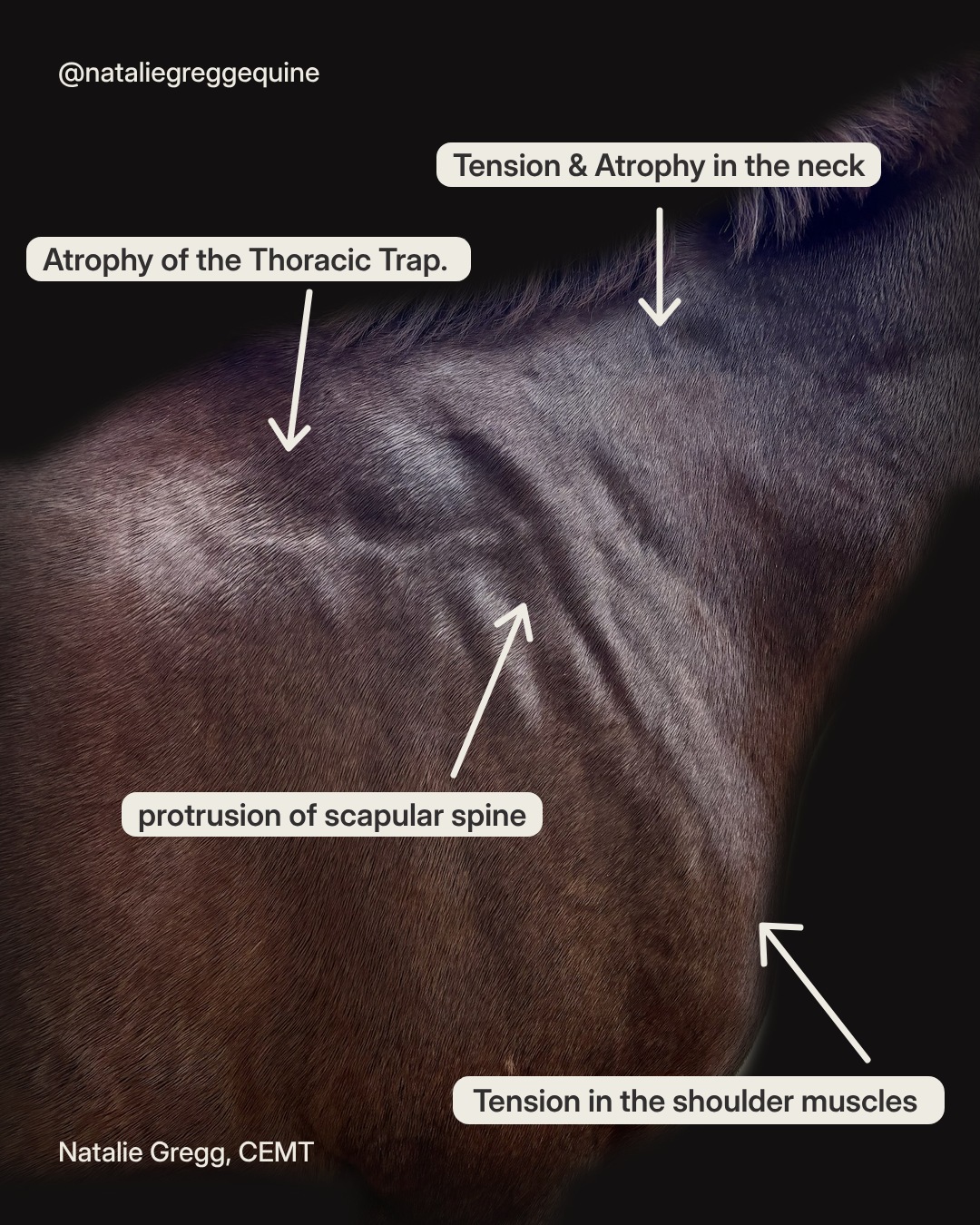
Tension and atrophy in the neck.The base of the neck is tight and thin where it should be full.
Atrophy of the thoracic trapezius.This is the muscle over the withers, and it sits closest to the front of the saddle. It's the first to suffer when a saddle pinches or sits too far forward.
A protruding scapular spine.The ridge of the shoulder blade stands out because the muscle that should cushion it has wasted away.
Tension through the shoulder muscles.The horse has been bracing against pressure for a long time.
When a saddle pinches or bridges, the horse moves away from the pressure. The muscle under it stops working properly and shrinks. The muscles around it pick up the slack and get tight. Ride after ride, the shape of the horse changes.
Other signs to watch for:
White hairs or rubbed spots under the saddle
Hollows forming around the withers
Dry spots in an otherwise even sweat mark that keep showing up in the same place
Pinning ears, swishing the tail or reaching around when you tighten the girth
Dropping or flinching when you run your hand down the back
Hollowing, a short or choppy stride, or trouble holding one canter lead under saddle
One odd sweat mark isn't a diagnosis. Look for patterns.
A saddle fitter can't fix a poorly muscled horse
Hot take: a good saddle fitter has every right to say, "This horse isn't in the condition to carry a saddle." That isn't bad service. That's honesty.
A saddle can hide a weak topline under a tree and padding. It doesn't solve it. The weakness is still there, and your horse is still compensating for it every time you ride.
The same goes for bareback. If you can't ride your horse bareback because their withers are too high and their back is uncomfortable, your horse probably doesn't have a topline healthy enough for a saddle either. Some horses do have naturally high withers, and conformation matters. But a strong, well developed topline fills in around those withers. Muscle is the padding your horse was built to have.
The fix is building the back: correct work, a saddle that fits, bodywork to release the tension holding them back, and time.
None of this happened in one ride
The horse in that photo belongs to a solid, well educated horsewoman. This isn't about blame.
Our industry as a whole is lacking in true equine anatomy and biomechanics education. We assume we can trust certain companies, certain trainers and big names, but this horse's body tells a very different story.
These changes build quietly. Nobody wakes up to a wasted trapezius. It happens a little at a time, ride after ride, until one day you notice the shoulder blade looks sharp or the saddle doesn't sit the way it used to. Your horse can't tell you the saddle hurts. Their muscles will.
What to do next
You don't need a degree in biomechanics to start reading your horse's back. Start here:
Ride bareback for a few minutesand notice where your seat settles. Then tack up and check whether your saddle puts you in the same place.
Look at your horse's withers and shoulderfrom the side, in good light. Look for hollows, white hairs, a sharp looking shoulder blade, or a neck that's thin at the base.
Check your sweat marksafter every ride for dry spots that keep showing up in the same place.
Bring in the right people:your vet to rule out pain, a qualified saddle fitter, and a bodyworker to release the tension and compensation a poor fit leaves behind.
Saddles can cause an incredible amount of pain and health issues, its not something to be played around with! As a bodyworker it is the #1 issue that causes muscle pain and damage. If a rider spends 5 -7 hours per week in an ill fitted saddle, and your bodyworker spends 1 hour per month with your horse... which one is going to win?